


A Process Model of Entrepreneurial Venture Creation: From business concept to first sale
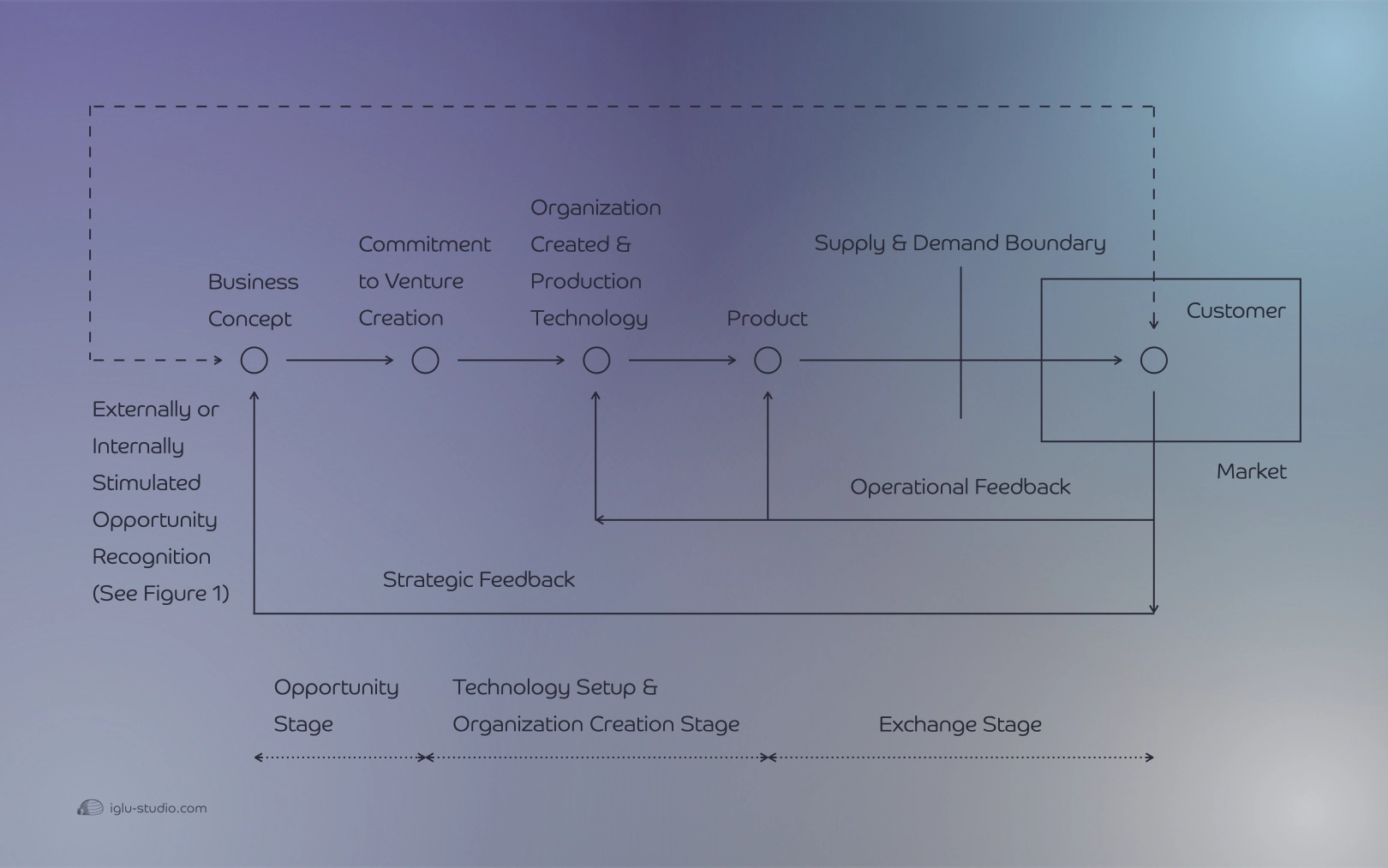
For a branding studio, truly understanding the genesis and evolution of a new venture is paramount. It’s not just about creating a logo or a tagline; it’s about crafting an identity that resonates with the core purpose and journey of a business. Mahesh P. Bhave’s process model of entrepreneurial venture creation offers an invaluable framework for this, particularly Figure 2 of the referenced article: "Process model of entrepreneurial venture creation". This comprehensive diagram, derived from interviews with entrepreneurs in upstate New York, illustrates the iterative, nonlinear, and feedback-driven journey from a nascent idea to a market-ready product.
This model provides a robust "road map" for prospective entrepreneurs and a deep well of insight for branding professionals, revealing the key stages, critical decisions, and inherent complexities involved in bringing a new business to life.
Decoding The Process Model: The Three Principal Stages
Bhave's model divides the venture creation process into three main stages for analytical convenience, each represented by a core variable: the Opportunity Stage, the Technology Setup and Organization-Creation Stage, and the Exchange Stage. These stages are marked by significant transition points, moving from the often invisible conceptual work to the more visible physical creation and market engagement.
Stage 1: The Opportunity Stage (Core Variable: Business Concept)
The initial phase of any venture begins with opportunity recognition, a subprocess we previously explored through the article "A Process Model of Entrepreneurial Venture Creation: How entrepreneurs recognize opportunities", which details the "internally stimulated" and "externally stimulated" routes. Whether an entrepreneur is driven by a pre-existing desire to start a business or by the identification of an unmet need, both pathways ultimately culminate in the identification of the business concept.
The business concept serves as the core variable for this stage and represents the successful completion of opportunity filtration, selection, and refinement. It defines the venture with sufficient focus, articulating its unique locational, product-market, or other features that provide a competitive advantage. This phase is where the entrepreneur can succinctly describe what sets their venture apart.
Novelty at the Business Concept: A crucial element for branding studios here is the degree of novelty embodied in the business concept.
• High Novelty: Ventures with truly novel business concepts, like JA's product innovation consulting services or GB's medical instrument, faced significant "missionary work" and customer education, essentially creating markets for their offerings. This demands a branding strategy focused on education, trust-building, and explaining the value of the unfamiliar.
• Low Novelty: Most ventures, however, are based on business concepts familiar to customers and respond to existing markets. For these, branding focuses on differentiation and achieving a clearer, better articulation of their offering compared to competitors.
The Opportunity Stage concludes with the Commitment to Physical Creation. This is a pivotal transition point; much of the effort before this is intangible, relying on the entrepreneur's time and thought. This commitment signifies the decision to seek and invest external resources, moving from an idea to tangible action.
Stage 2: Technology Setup and Organization Creation (Core Variable: Production Technology)
Following the commitment to physical creation, entrepreneurs focus on garnering resources, setting up production technology, and creating the organization necessary to transform their business concept into a marketable product. The production technology is the core variable for this stage.
• Production Technology Novelty: While most businesses use standard equipment and technology, a few introduce high-novelty production technology. This often involves developing proprietary technologies in laboratories, which significantly increases uncertainty, requires risk capital, and makes venture creation qualitatively more hazardous. For branding, this type of activity might highlight innovation and advanced capabilities.
• Organization Creation: This process occurs in parallel with technology setup. New ventures frequently display fluid departmental boundaries, limited functional differentiation, and entrepreneurs assuming multiple roles. This "formlessness and frenetic pace" gradually gives way to formalization as customer feedback and learning guide the evolution of structures and practices. Branding can help articulate the nascent culture and vision even in these early, dynamic phases.
This stage is primarily about making the product ready for the customer.
Stage 3: The Exchange Stage (Core Variable: Product)
The final stage, the Exchange Stage, begins when the product, or service, is sold to customers for the first time, thereby completing the entrepreneurial loop. The product is the core variable here, representing the marketable form of the business concept.
• Product Novelty: Approximately one-third of the businesses in the study introduced high-novelty products, often requiring significant product development, which can delay introduction and add risk. Branding needs to communicate this novelty effectively to the market.
• The Supply and Demand Boundary: The figure explicitly depicts a boundary between the entrepreneurial firm (supply side) and its customers (demand side). Many entrepreneurs had initial customers lined up even before physical product creation, highlighting the importance of early market validation.
Crucially, this stage involves continuous customer feedback. This feedback is vital and can be categorized:
• Operational Feedback: Relates to product features, quality, and pricing. This type of feedback calls for tactical changes, such as revisions to existing equipment or slight alterations to production technology.
• Strategic Feedback: Such data is far more critical, as it affects the business concept itself. It signals the emergence of substitutes, radical shifts in customer needs, or fundamental flaws in the venture's core premise. Failure to act on strategic feedback can undermine the entire business, potentially requiring a major reorientation. Branding must be agile and responsive, ready to adapt messaging and positioning based on such pivotal market signals.
The first sale is identified as a significant conceptual event in this stage. It vindicates the business concept, establishes an exchange relationship with customers, and bridges the supply and demand boundary, providing crucial initial feedback.
The Iterative and Conceptual Heart of the Model
The figure is not a rigid linear progression; its dashed lines and feedback loops are critical. These represent the iterative, conceptual process that underpins physical creation. Even before physical creation begins, entrepreneurs are constantly evaluating opportunities against markets (dashed line from Business Concept to Market). After physical creation, direct feedback loops ensure that market response constantly informs and potentially modifies the product, production technology, and even the fundamental business concept. This ongoing, non-chronological refinement is a core part of the entrepreneur's effort and explains their deep attachment to their ventures.
Implications for Branding Studios
Bhave's comprehensive model offers profound insights for branding professionals:
1. Crafting Authentic Narratives: Understanding the specific pathway a venture took (e.g., problem-solving driven by an unmet need vs. a market-search approach) and the novelty introduced at each stage allows a branding studio to develop a truly authentic and compelling brand story.
2. Strategic Positioning and Messaging: The model highlights that ventures differ significantly based on the novelty they introduce in their business concept, production technology, and product. A highly novel concept requires a branding strategy focused on education, market creation, and establishing trust. A low-novelty concept demands branding that sharpens differentiation and competitive advantage.
3. Anticipating Challenges: By understanding where a venture sits within this model, studios can anticipate potential marketing and communication challenges, such as the "missionary work" required for novel concepts or the need for quick responses to feedback in fast-paced markets.
4. Guiding Evolution: The iterative nature of the model and the distinction between strategic and operational feedback empower branding studios to advise on dynamic brand management. Brands must be built not just for launch but for continuous adaptation, ready to reorient based on critical market signals.
In conclusion, Mahesh P. Bhave’s Process Model of Entrepreneurial Venture Creation transcends a simple flowchart. It’s a dynamic depiction of the entrepreneurial spirit, a guide through the complexities of bringing an idea to fruition, and an essential framework for Iglu Studio aiming to build not just brands, but enduring legacies. By grounding branding strategies in this profound understanding of the venture's journey, Iglu Studio can forge identities that truly reflect the essence and trajectory of their entrepreneurial clients.
Source Metadata
• Title: A Process Model of Entrepreneurial Venture Creation
• Author: Mahesh P. Bhave
• Journal: Journal of Business Venturing
• Publication Year: 1994
• Volume and Issue: Volume 9, Issue 3
• Pages: 223–242
• Publisher: Elsevier Science Inc.
• ISSN: 0883-9026
• DOI: 10.1016/0883-9026(94)90031-0